Urgent Care in Barcelona: 112, 061, CUAP Centers or the Hospital
Catalonia's public health service has a clear order for urgent care: phone first, then your CAP, a CUAP or the hospital. Here is which to use and what to bring.

In Barcelona, call 112 for any emergency where a life is at risk, and 061 Salut Respon for urgent health problems that are not life-threatening. 061 runs 24 hours a day and tells you where to go. Less complex urgent cases go to your CAP or a CUAP urgent care center; hospital emergency rooms are for the most serious cases.
When should you call 112 or 061?
The Catalan emergency medical service, the SEM, describes 112 and 061 as two connected services, so calling either one does not make you wait longer.
| Number | Use it for | What it can do |
|---|---|---|
| 112 | Emergencies needing immediate action: serious accidents, fires, assaults, robberies, life-threatening medical situations | Sends police, fire service or ambulance |
| 061 Salut Respon | Health questions and urgent problems that are not an emergency | Medical and nursing advice, tells you which center to go to, can send a doctor to your home or an ambulance if needed |
CatSalut, the Catalan health service, recommends 061 as the first option for urgent care. The Ajuntament’s international welcome office says the 061 helpline has a translation and interpreting service. The SEM also lists a 061 Salut Respon app, a web chat and a sign-language service.
Other useful numbers: the police (Mossos d’Esquadra and Guàrdia Urbana) and the fire brigade can all be reached through 112, so you do not need separate numbers in an emergency.
Where should you go for urgent care?
CatSalut sets out this order on its urgent care page:
- Call 061 if you are not sure where to go.
- Your CAP (centre d’atenció primària, local health center) handles urgent problems during its opening hours.
- The urgent care center you are assigned, a CUAP or a CAP with continuing care (atenció continuada), when your CAP is closed.
- A hospital emergency department for the most serious cases. Patients whose lives are at risk always go first.
Going straight to a big hospital with a minor problem usually means a long wait, because hospital emergency departments sort patients by severity, not arrival time.
What is a CUAP?
A CUAP (centre d’urgències d’atenció primària) is an urgent primary care center. According to CatSalut, CUAPs treat urgent health problems of low and medium complexity, and most can do blood tests and X-rays. Most are open 24 hours a day, every day of the year, though in some areas they open for 12 hours.
If you are unsure whether a problem fits a CUAP, call 061 first. Signs of a heart attack or stroke, severe breathing difficulty, heavy bleeding and serious injuries are emergencies: call 112.
To find the CUAP or continuing-care center assigned to your address, use CatSalut’s health center finder, or ask 061. Your CatSalut health card application also tells you which CAP you belong to.
What should you bring?
- An identity document: CatSalut asks everyone to show one, such as your passport, TIE or EU ID card.
- Your TSI health card, or its personal identification code (CIP), if you have one. Other documents proving your right to public care are also accepted.
- A list of your medicines, allergies and relevant medical history, ideally in Spanish or Catalan.
- Your phone, charged, and a charger: waits can be long.
Urgent care in the public network is covered by public funding for people entitled to it. Visitors from other EU countries should bring a European Health Insurance Card; see using an EHIC or GHIC in Barcelona. Travelers without public coverage should carry their travel insurance details, because private clinics charge for care.
What happens when you arrive at urgent care?
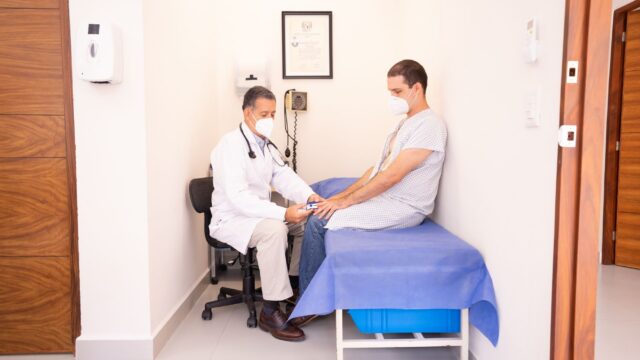
At a CUAP or hospital, staff first assess how serious your problem is, a step called triage. CatSalut says urgent care is organized by severity, so people with life-threatening conditions are seen before others, regardless of arrival time. Expect a wait if your case is minor, and tell staff if your symptoms get worse while you wait.
After treatment you normally receive a written report (informe d’alta) describing what was done. Keep it and show it to your family doctor at your CAP at the follow-up visit.
How do you find an out-of-hours pharmacy?
Barcelona has duty pharmacies (farmàcies de guàrdia) open at night and on holidays on a rotating basis. Pharmacies that are closed usually display the nearest duty pharmacies on their door. You can also ask 061 or check the duty rota published by the Barcelona pharmacists’ association.
Medicines prescribed in the public system are dispensed against your health card, so bring the TSI or its code to the pharmacy.
Bottom line
Save 061 in your phone today and look up which CAP and CUAP serve your address before you need them. When in doubt about severity, call: the doctors and nurses on 061 can tell you if you need a home visit, a CUAP or an ambulance.
FAQ
Is 112 free from a mobile phone?
Yes. 112 is the free European emergency number. Use it only for real emergencies, and use 061 for health questions.
Can I go to the hospital directly?
Yes, but CatSalut reserves hospital emergency rooms for the most serious cases, and CatSalut says less urgent cases can be seen in primary care. For anything life-threatening, call 112 instead of traveling yourself.
Do I need a TSI to be treated in an emergency?
You will be asked for an identity document and, if you have one, your TSI or its code. In a life-threatening situation, call 112 and sort out documents later.